What is ERP
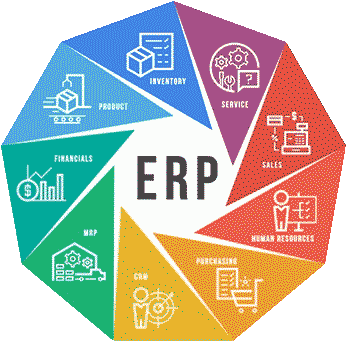
ERP stands for "Enterprise Resource Planning" and refers to software and systems used to plan and manage all the core supply chain, manufacturing, services, financial and other processes of an organization. Enterprise Resource Planning software can be used to automate and simplify individual activities across a business or organization, such as accounting and procurement, project management, customer relationship management, risk management, compliance and supply chain operations.
Individual ERP applications can offer software as a service (SaaS), while a complete suite of ERP applications forms an ERP system that can be used to effectively communicate and bring together business processes to enable a flow of data between the applications, typically through common databases either on-site/on-premise or in the cloud.
ERPs connect every aspect of an enterprise. An ERP software system allows for better performance and project management that helps plan, budget, predict and accurately report on an organization’s financial health and processes.
How Does an ERP System Work?
The main purpose of an ERP system is to increase organizational efficiency of an organization by managing and improving how company resources are utilized. Improving and/or reducing the number of resources necessary without sacrificing quality and performance are keys to effectively improving business growth and profitability.
ERP systems typically cover all aspects of business operations and commonly provide: * An integrated system * Common database * Real-time operation * Support for all applications/components * Common user interface across application/components * On-premise, cloud hosted, or SaaS deployment
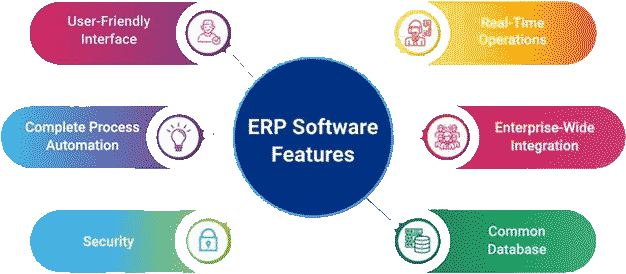
ERP software has the ability to collect and compare metrics across departments and provide a number of different reports based on roles or specific user preferences. The data collected makes finding and reporting on data faster and gives a complete view of business performance with complete insights on how resources are being spent.
ERP synchronizes reporting and automation by reducing the need to maintain separate databases and spreadsheets that would have to be manually merged to generate reports. This combined data collection and reporting offers valuable insight, such as where to cut costs and streamline processes, providing the information to make real-time business decisions.
Types of ERP Systems: Cloud vs On-Premise vs Hybrid
There are three main types of ERP systems that function with different deployment model options. The most common types of ERP systems include cloud ERP, on-premise ERP, and hybrid ERP.
On-Premise ERP software is implemented onsite and maintained in physical office space within an organization, hosted on the company’s own computers and servers for full control, support and ownership of the entire system once implemented.
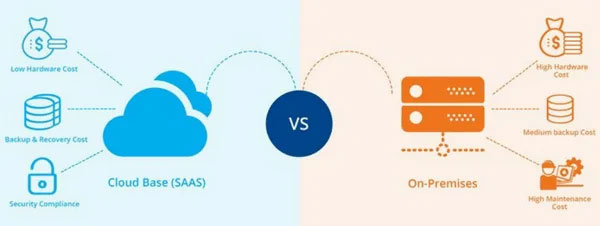
Cloud-based ERP software is a web-based solution, known as Software as a Service (SaaS), where an organization accesses and stores data on any device with an internet connection, usually through the purchase of a subscription. Continual support, updates, training, and flexible customizations supported by the software provider.
“Hybrid” ERP software refers to a combined implementation of cloud-based and on-premise ERP system solutions. The combination of hosting and deployment services vary by provider. These models can provide ERP users the flexibility to migrate between delivery models, or integrate benefits not available existing implementation.
Different ERP vendors support different deployment model options. Combinations of options, often referred to as “hybrid” deployment may offer a combination of hosting and deployment services. These models can provide ERP users flexibility migrate between delivery models, or integrate benefits not available existing implementation.
We normally provide fixed customised menu(s) along with our base template website.
Our Solutions
Problem Understanding
Having spent a lot of years understanding the broad and specific business requirement, we have a fairly good understanding of how to first translate a real world problem into logical structures then to further ensure that the solution is so designed that it works on zero fault and also has a scope for scalability as and when need arises
Minimum Hardcoding
Its a common belief that any system designed must be a fast learner and able to adapt and incorporate new changes be it in the business process, the underlying labrynth of software and hardwares components or just plain simple look and feel to remove monotonity. After years of research working with various front and backend programming languages, databases, servers etc we have finally created dynamic tools for all aspects so in many cases, even the complicated time consuming programmer job have been reduced to uploading a few excel files and the system handles it to perfection
From droplet to ocean
Every long journey begins with a single step, we believe that the initial steps are the most crucial as they set the foundation for a bigger enterprise. These may look out of place when small but leads to bottlenecks later. Our future projections, load balancing techniques at every stage ensure robustness, scalability, and longevity. Utiling the best of today with an eye towards the changes of tomorrow is our motto.
Easy Costing
A software is a blackbox, so calculating the cost of a software is always tricky. Our charge are based on number of input screen and desired output layouts, any intermediate programming used is not charged.